Blender 5.3 adds native Gaussian splats, from import to Cycles renders
The developer blog walks through initial 3D Gaussian splat support in the Blender 5.3 beta: .PLY, .SPZ and USD import, Geometry Nodes access, and rendering in EEVEE, Workbench and Cycles.
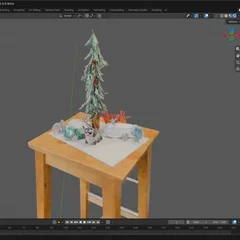
Blender 5.3 will ship with initial support for 3D Gaussian splats. The news comes straight from the Blender Developers Blog, where Anastasia Rudina posted a walkthrough on 30 October. You can try it now in the 5.3 beta builds. We haven’t tested it ourselves yet, so everything below comes from the blog post.
What a splat is
Gaussian splatting turns a set of photos into a 3D capture. It isn’t a mesh. It’s a radiance field made of many tiny Gaussian blobs, a bit like a point cloud, but able to hold materials, lighting, transparency, hair and fine detail in one object. Splats have become a popular way to capture real places and props, and until now, getting them into Blender meant using third-party add-ons.
Getting splats in
Blender 5.3 imports splats in the .PLY and .SPZ formats and can also load them from USD files. You drag a file into the viewport and confirm the import. To show it off, the team scanned the real physical props from its DOGWALK game at Blender HQ, and the capture is free to download from the post.
Under the hood, splats are a type of point cloud. A new Pointcloud Type node exposes them in Geometry Nodes, along with attributes for position, 3D scaling, rotation and radiance. Radiance stores the view-dependent lighting as spherical harmonics, and you can write splat color directly in Geometry Nodes.
Rendering in all three engines
All the built-in renderers support splats. EEVEE and Workbench rasterize them, using EEVEE’s dithered transparency. The blog warns that this is noisy for now, so it suggests raising EEVEE’s sample count. In Workbench, set Viewport Shading > Lighting to Flat for the expected look.
Cycles takes a different route. It traces rays against each splat, which means splats work with reflections and indirect lighting. The trade-off is that EEVEE and Cycles renders can look slightly different, since most splat data is fitted for the rasterized approach.
Relighting is possible in both engines by swapping the default emissive material for another shader. The developers call this early-stage, because it still relies on the captured, view-dependent color.
What’s still missing
The team lists three open issues. EEVEE wastes time drawing splats hidden behind other splats, which hurts on low-powered machines. Editing still uses the regular point cloud tools, which the post admits feel clunky. Better relighting may need albedo extraction. Follow-up work is on the Blender roadmap as a Gaussian Splatting Improvements project.
For animators and layout artists, the pitch is simple: a phone capture of a real set or prop could sit right in a Blender scene and render with everything else.
Sources: Splatting the Gaussians into Blender, Blender Developers Blog, Blender daily and beta builds, Blender roadmap.
Thumbnail: Blender Foundation, from the Blender Developers Blog (CC BY)